





Cosy Window Dressing Ideas for Autumn | Suffolk Home Guide
The best autumn window dressings combine a thermal or textured layer for warmth with a lighter sheer layer for daytime privacy and light control. Shutters, lined curtains, and cellular blinds all reduce draughts and heat loss. Choosing made-to-measure options ensures a snug fit — especially important in older Suffolk homes with deep recesses or bay windows.
There's a particular moment every September where you close the front door, feel a slight chill on your ankles, and think oh, here we go. The heating goes on "just for ten minutes". Three hours later, it's still running.
Your windows are a big part of why that happens. Single-glazed sashes, Victorian bays with multiple joints, draughty frames — Suffolk homes come with a lot of charm, and occasionally a lot of cold air. The right window dressings won't just make a room look cosier; they'll genuinely help it feel warmer, retain heat better, and keep your home private as the evenings draw in.
This guide covers practical cosy window dressing ideas for every room, with advice on layering, materials, and when thermal shutters or energy efficient blinds might be worth considering. We also fit made-to-measure shutters across Ipswich and Suffolk, so if anything here sparks an idea, we're always happy to chat.
Why autumn is the perfect time to rethink your windows
It's not just about aesthetics. As temperatures drop, windows that were perfectly fine in July start to reveal their shortcomings. Heat escapes through gaps in frames, cold air settles against glass and drops into the room, and the shift from long summer evenings to short, dark afternoons changes how much privacy you actually need.
Earlier darkness means your lit-up living room is visible from the street well before 6pm. Glare from low autumn sun can be blinding in the mornings but almost non-existent by mid-afternoon. And if you've got older frames or a beautiful but draughty bay window, the thermal performance of your coverings starts to matter a lot more.
Thermal shutters and energy efficient blinds exist precisely for this — they're not just window coverings, they're an active layer of insulation. But even without going full renovation mode, there are straightforward autumn window dressings that make a real difference.
Cosy window dressing ideas that don't block out all the daylight
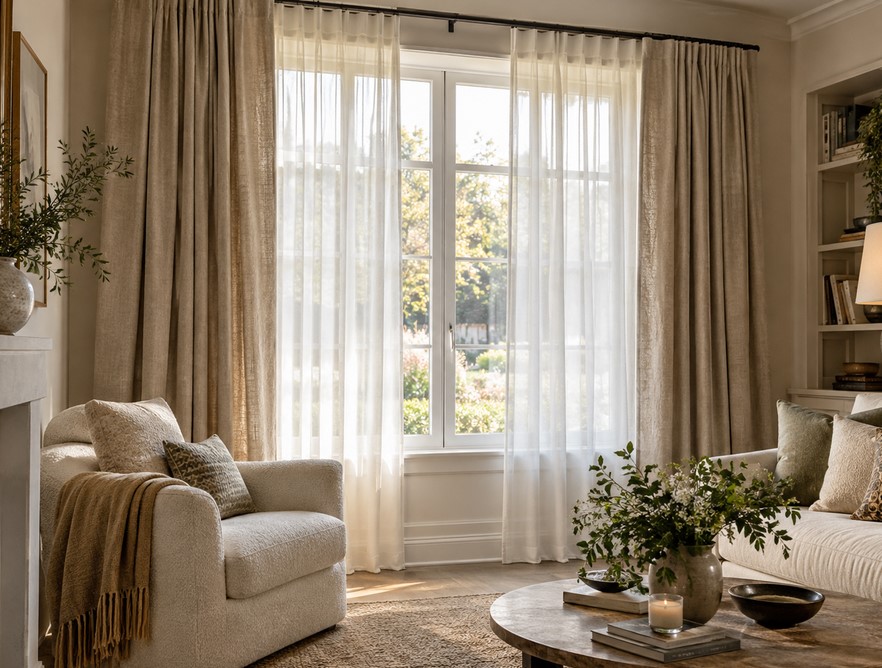
The biggest mistake people make in autumn is reaching for the heaviest, darkest curtains they can find — and ending up living in a cave.
Layering 101: sheer + cosy layer
The most effective approach is layering. A sheer voile or linen panel sits closest to the glass, letting in diffused daylight while taking the edge off cold air. Behind it, a heavier curtain or shutter panel gives you full privacy and warmth in the evenings. You get the best of both without sacrificing natural light during the day.
Shutters and curtains work brilliantly together, too. A plantation shutter handles the daytime — louvres tilted to bring in light — while a soft curtain adds warmth and texture in the evenings.
Texture is doing the heavy lifting
When it comes to visual warmth, texture earns its keep. Velvet, brushed cotton, wool-blend, and heavier linen fabrics all absorb light slightly, which makes a room feel immediately cosier. You don't need autumnal orange to achieve a seasonal feel — warm whites, soft taupe, muted sage, and putty tones all read as warm without being oppressive.
The key is contrast with the window itself. Lighter walls and furniture let you go heavier at the window without losing brightness.
Don't forget the hardware
A curtain hung too low from a flimsy pole won't do much for draught reduction. Ceiling-height poles or tracks draw the eye up and allow curtains to cover more of the wall — which helps trap a layer of warm air between the fabric and the glass. Pelmets do the same job at the top of the window.
For period homes around Suffolk, subtle brass or iron hardware tends to complement older features well. Modern interiors usually benefit from cleaner, minimal track systems.
Autumn window dressings that help with warmth (and your heating bill)
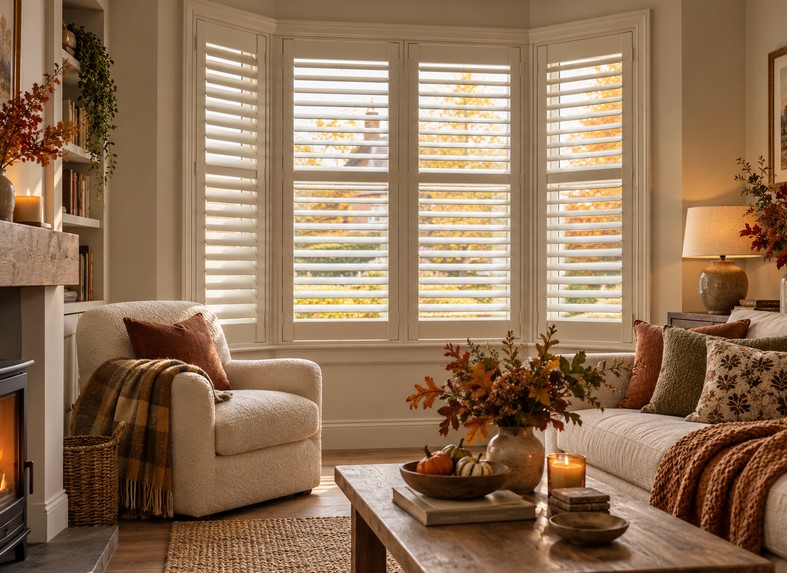
What makes a window covering feel warmer?
It comes down to fit, coverage, and air gaps. A covering that sits snugly within the window recess traps a thin layer of still air between the glass and the room — that air acts as insulation. The wider the gap, or the more draughts can circulate around the edges, the less effective it becomes.
This is why made-to-measure always outperforms off-the-shelf. A blind or shutter measured precisely to your window will perform significantly better than one that almost fits.
When thermal shutters make sense
Thermal shutters are a good fit when you want something that looks tidy, lasts a long time, and works hard all year. Because shutters are fitted directly to the window frame, they sit close to the glass and minimise the gap where cold air tends to pool.
They're particularly worth considering in older properties — the kind of Victorian terrace or bay-fronted home you'll find across Ipswich and much of Suffolk — where frames may not be perfectly square and standard blinds never quite sit right. Careful measuring is essential here, which is exactly where a local installer who knows the area's housing stock makes a difference.
Energy efficient blinds: what to look for
If you prefer a blind to a shutter, look for options that fit within the recess with minimal side gaps. Cellular (honeycomb) blinds trap air in individual pockets, which improves their insulating performance noticeably compared to a standard roller. A thermal lining on Roman blinds has a similar effect.
Layering an energy efficient blind with a curtain panel gives you the most flexible setup — light and airy during the day, well-insulated and private at night.
Room-by-room ideas (with real-world Suffolk homes in mind)
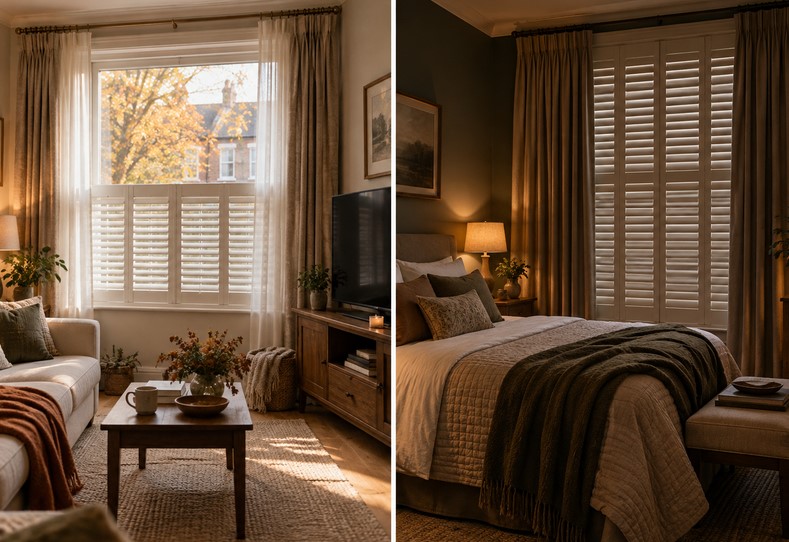
Living rooms: cosy without turning the telly into a mirror
Low autumn sun causes havoc with screens. Cafe style shutters — covering just the lower portion of the window — are a neat solution: they reduce glare and maintain privacy from street level while leaving the upper window open for light. Tier on tier shutters give you even more flexibility, letting you adjust top and bottom panels independently.
For a more relaxed look, a sheer layer during the day paired with a textured curtain for evenings gives you control without the room ever feeling shut off.
Bedrooms: darker, quieter, warmer
Bedrooms benefit most from full coverage. Full height shutters — running from floor to ceiling — give clean lines, strong light control, and genuine privacy. They're a particularly good fit for bedrooms that face a street or neighbouring property, which is a common layout in Suffolk's older terraced housing.
If you want maximum blackout, pairing shutters with a lined curtain panel gives you layers of both warmth and darkness.
Bay windows: make them a feature, not a faff
Bay windows are one of Suffolk's most distinctive architectural features — especially the Victorian bays you'll find in abundance around Ipswich. They look beautiful, but they're notoriously awkward to dress.
Bay window shutters are, genuinely, one of the best solutions available. They follow the shape of the bay, control light independently across each panel, and provide privacy without the clunky track systems that standard bay curtains often require. They also make the bay itself a feature rather than an afterthought.
Kitchens and bathrooms: warmth plus practicality
These rooms need coverings that can handle moisture, splashes, and steam. Bathroom shutters and kitchen shutters made from moisture-resistant materials are easy to wipe clean and hold up far better than fabric in humid environments. Cafe style shutters work especially well in kitchens — they give privacy from the garden or a neighbouring window while keeping the upper portion open for light.
Conservatories and tricky shapes
Shaped windows — gable ends, loft skylights, angled frames — are a particular challenge with off-the-shelf products. Made-to-measure shaped or angled shutters are designed precisely for these spaces. If you've got an unusual window that's never been dressed quite right, it's usually because the solution needed to be made for it specifically.
Styling shortcuts for instant autumn cosiness
You don't need to redecorate to make a room feel more autumnal. A few adjustments at the window go a long way:
Warm neutrals work hardest. Soft whites, warm greys, taupe, and dusty green all read as cosy without dating quickly.
Echo the window textile elsewhere. A cushion or throw in a similar fabric weight or colour ties the room together without any major effort.
Swap voiles seasonally. Lighter sheers in summer, heavier linen or cotton blends come autumn — a simple change that shifts the whole feel of a room.
Quick checklist: getting the fit right (and avoiding common mistakes)
Before you buy or order anything, run through these:
Measure properly — or have someone do it for you. Gaps around the edges are where heat escapes and draughts get in.
Check how your windows open. A blind fitted too close to a casement handle is going to cause problems.
Mind the radiator. Long curtains that sit over a radiator push warm air towards the window rather than into the room.
Think about cleaning. Fabric gathers dust; shutters and hard blinds are far easier to maintain in kitchens and bathrooms.
Plan for daily use. Whatever you choose should be straightforward to open and close — if it's fiddly, it won't get used.
We don't rush the measuring stage — it's where a well-fitted installation really starts. Every home visit includes time to talk through what'll work best for your windows, room, and daily routine before we quote for anything.
FAQs
What are the best autumn window dressings for keeping heat in?
Anything that fits snugly and minimises air movement around the glass. Thermal shutters and cellular blinds are both strong performers. Lined curtains — especially with a thermal interlining — add warmth when layered with a closer-fitting blind or shutter. The snugger the fit, the more effective the covering.
Are thermal shutters worth it in older Suffolk homes?
Generally, yes. Older properties often have non-standard frames and deep recesses where standard products don't fit well. Made-to-measure shutters are fitted directly to the frame, which reduces draughts noticeably. They're also durable and low-maintenance — a practical long-term investment rather than a seasonal fix.
What's the difference between energy efficient blinds and shutters?
Shutters are rigid, frame-fitted, and provide strong insulation through a close fit and solid construction. Energy efficient blinds — particularly cellular or honeycomb designs — use trapped air pockets to insulate. Both can work well; shutters tend to be more durable and better suited to awkward window shapes, while blinds offer a softer look and a lower initial cost.
Do shutters work well for bay windows?
Very well. Bay window shutters follow the angle of the bay, allowing each panel to be controlled independently. This makes them ideal for managing light and privacy across a large, multi-paned window — something standard curtain tracks often struggle with.
Can I still get privacy without blocking daylight?
Yes. Cafe style shutters (covering the lower half only), tier on tier shutters, and louvred shutters with adjustable tilt all let you manage privacy and light independently. Sheer curtains layered behind heavier panels achieve a similar effect with soft furnishings.
Are shutters suitable for kitchens and bathrooms?
Yes, provided they're made from a moisture-resistant material. Bathroom and kitchen shutters are specifically designed for humid environments — they won't warp, swell, or deteriorate the way wood or fabric can. They're also easy to wipe clean, which matters in those rooms.
How long does it take to have shutters fitted?
Selected ranges can be fitted in as little as two weeks, though timescales vary depending on the style, size, and material chosen. We'll give you a clear indication of lead time when we quote — no vague estimates.
Do you cover my area in Suffolk?
We install shutters across Ipswich and throughout Suffolk, including Woodbridge, Felixstowe, Stowmarket, Needham Market, Hadleigh, Sudbury, Bury St Edmunds, Saxmundham, Aldeburgh and surrounding villages. If you're not sure whether we cover your area, just give us a ring and we'll let you know.
Ready to make your home feel cosier this autumn?
If your windows have been on your to-do list for a while — or you've just noticed the first cold draught of the season — now's a good time to sort them out before winter arrives in earnest.
We're a local company, not a faceless online supplier. We work in homes across Ipswich and Suffolk regularly, we know the area's housing stock, and we take the time to measure properly and give you a clear, no-nonsense quote. We're also proud to be a Which? Trusted Trader and were recognised in the 2021 Home and Garden Awards.
Whether you're interested in plantation shutters for a Victorian bay, full height shutters for a bedroom, or something moisture-resistant for a bathroom, we're happy to talk through the options.
