



Best Blinds for Conservatories in Suffolk | Expert Guide
The best blinds for conservatories depend on what's bothering you most. For overheating, solar-reflective or pleated blinds work well. For winter warmth, thermal options with a snug fit are ideal. For privacy without losing light, consider top-down/bottom-up styles or shutters. Made-to-measure is almost always worth it in a conservatory.
There's a particular kind of disappointment that comes with a conservatory in summer. You built it to enjoy the garden view. What you got was a room that hits 30°C by 10am, where the sofa cushions are fading and the TV screen is basically a mirror. Then winter arrives, and it's so cold you've stopped using it entirely.
Sound familiar? If you're searching for the best blinds for your conservatory in Suffolk, you've come to the right place. This guide covers everything you need to know — blind types, materials, heat control, privacy, fitting, and a few honest mistakes to avoid — so you can actually enjoy the room you paid good money for.
If you'd like tailored advice before reading on, we're happy to help — just get in touch here.
What makes conservatory blinds different from "normal" blinds?
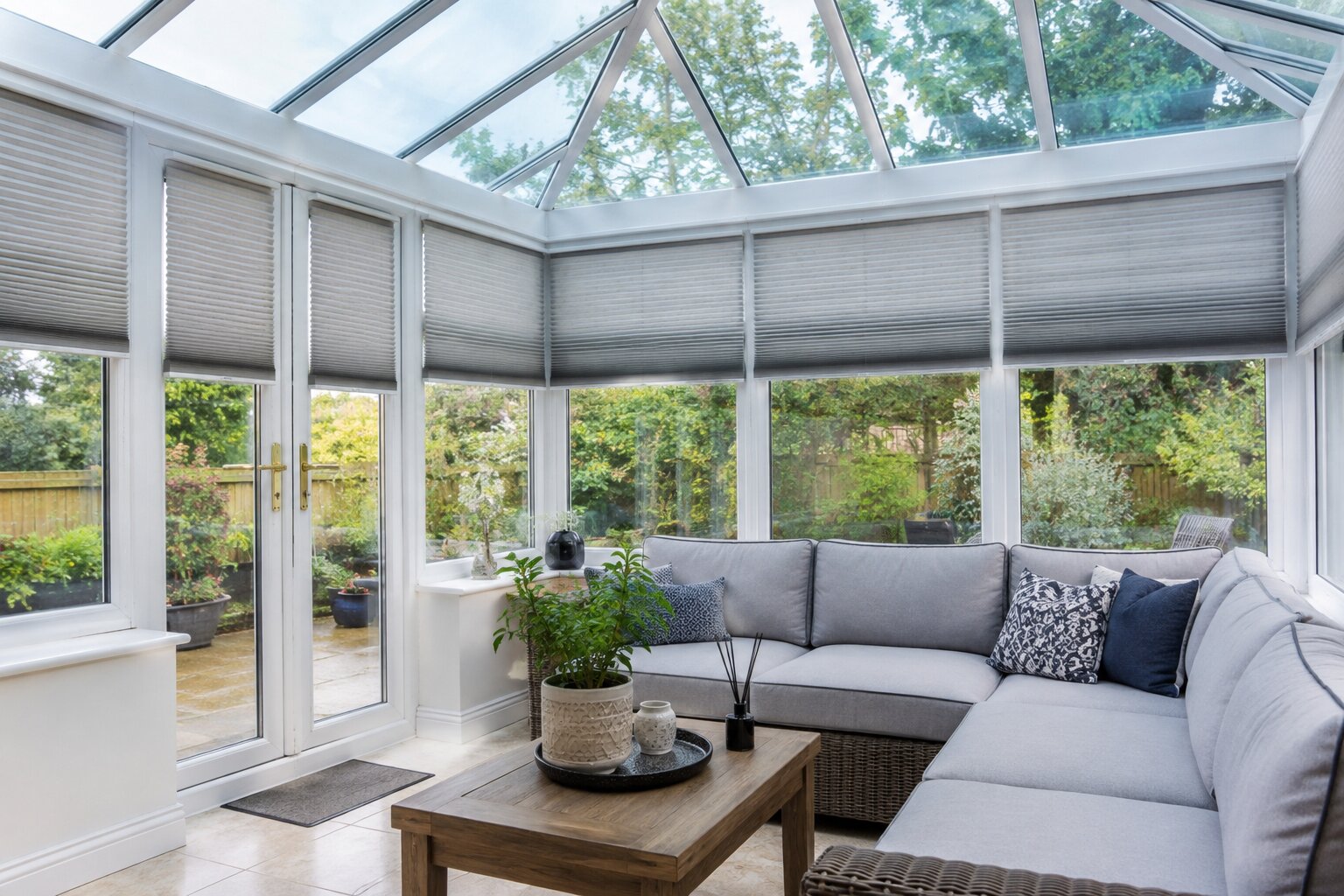
A standard bedroom or living room blind has one job: look decent and block some light. Conservatory blinds have to work a lot harder than that.
The biggest challenge is temperature. All that glass creates serious solar gain in summer and rapid heat loss in winter. Throw in UV rays that fade furniture, awkward angled frames, roof panels that most standard blinds simply can't reach, and the occasional issue with condensation — and you've got a room that demands something purpose-built.
Fit matters enormously here. A blind that's slightly too narrow leaves a gap around the frame, and that gap lets in light, heat, and draughts. In a standard room, a centimetre of light bleed is mildly annoying. In a conservatory, it defeats the point entirely.
Quick guide: choosing the right conservatory blinds for your situation
Not sure where to start? Here's a simple decision framework:
Overheating in summer? Prioritise solar-reflective or light-filtering fabrics, and don't ignore the roof panels — that's where most of the heat enters.
Too cold in winter? Thermal conservatory blinds with a close, snug fit will make the biggest difference. Honeycomb/duette styles are particularly effective.
Privacy from neighbouring gardens? Consider top-down/bottom-up options, shutters, or layered solutions that give you control without closing the room off completely.
Using the space for work or watching TV? Glare control is your priority. Look for adjustable options like Venetian or pleated blinds.
A room that does everything? Flexible, adjustable styles — or a combination of blinds and shutters — tend to work best.
The most popular types of conservatory blinds
Pleated blinds
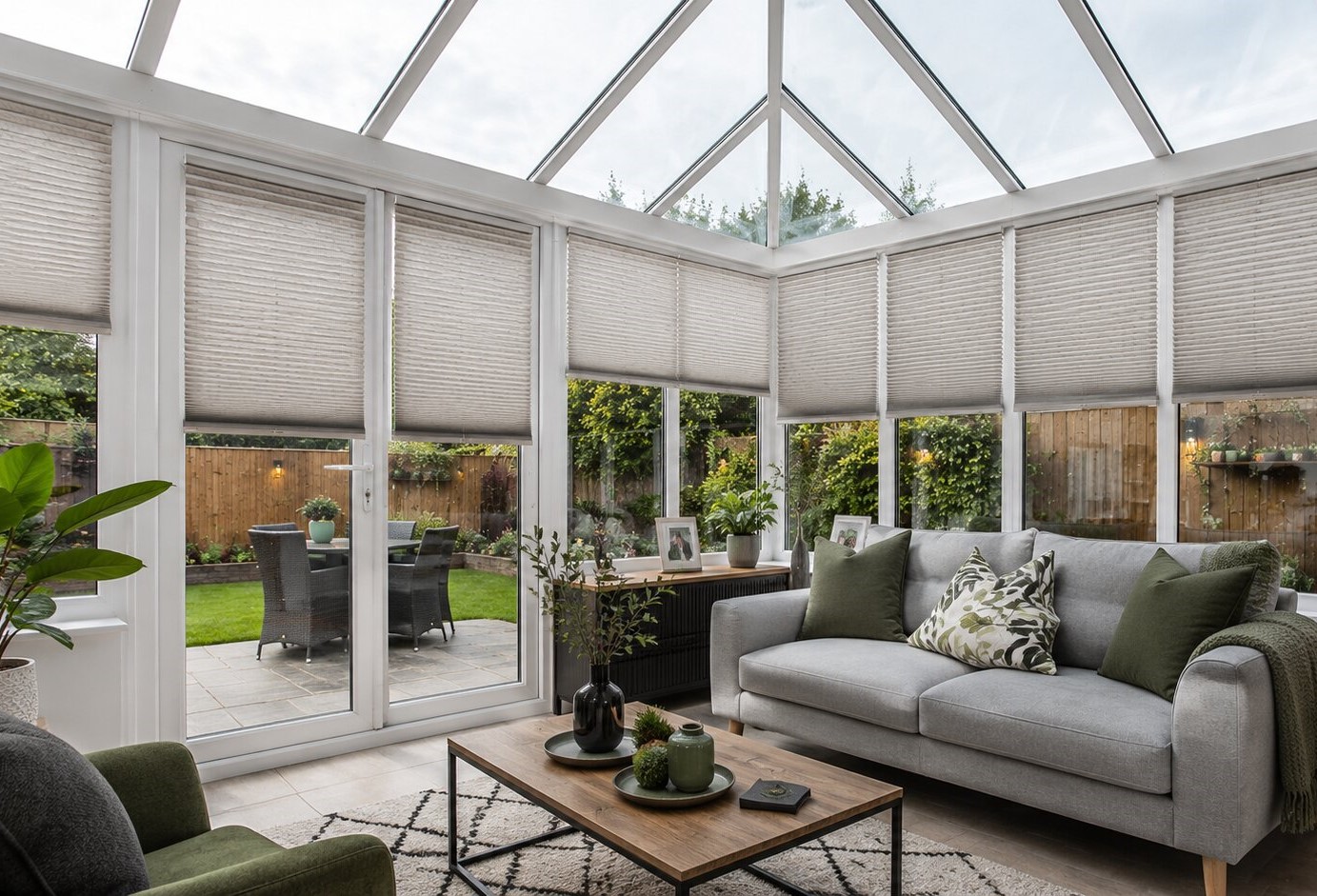
Pleated blinds are one of the most popular choices for conservatories, and it's easy to see why. Their slim, compact profile suits the narrower frames you often find in uPVC conservatories, and they can be made to fit side windows and roof panels when the right system is used.
They're available with thermal or solar-control fabrics, which makes them genuinely useful rather than just decorative. A good pleated blind will soften harsh Suffolk summer light without making the room feel like a cave.
Roller blinds
Clean, minimal, and available in a wide range of fabrics — roller blinds are a solid choice for conservatory side windows. For a room that overheats, a solar-reflective roller blind can take the edge off without blocking your view of the garden. For rooms used in the evening, a more opaque fabric will give you better privacy.
They work well in modern conservatories and glazed extensions where a neat, unfussy look is the goal.
Vertical blinds
Vertical blinds are particularly well suited to wide glazed areas and conservatory doors. The louvres can be tilted to manage glare as the sun moves around during the day, or drawn to one side when you're going in and out. They're not everyone's first choice on style grounds, but they do a practical job well.
Venetian blinds
If light control is your main concern, Venetian blinds give you more precise adjustment than most other styles. You can tilt the slats to redirect sunlight rather than simply blocking it — which is useful in rooms where you want to keep the space bright but cut the glare on a screen.
Worth noting: they do collect dust on the slats, and after a pollen-heavy Suffolk spring, cleaning them is a bit of a commitment.
Roof blinds
If your conservatory has a pitched or flat glazed roof, the side windows alone won't solve your overheating problem. Roof blinds are designed specifically to sit within or against overhead glazing, and they make a genuine difference to comfort on sunny days.
They require careful measuring and the right system for your roof's pitch and structure, so it's worth getting professional advice before ordering.
Perfect fit blinds
Perfect fit blinds clip directly into the window bead rather than mounting onto the surrounding wall or frame. This creates a tidy, integrated look and means the blind moves with the window or door — which is particularly useful in conservatories where handles and vents can make traditional fixing awkward.
Made to measure conservatory blinds: why fit matters more than you think
Here's something we see regularly when we visit homes across Ipswich and Suffolk: a conservatory fitted with blinds that almost work. They're a bit short. They let the light bleed in at the edges. The ones on the doors catch on the handle every time someone tries to open them.
Made-to-measure blinds aren't just about aesthetics. A snug, properly fitted blind performs significantly better for heat control, insulation, and glare reduction. It's also safer, more durable, and easier to operate day to day.
Conservatories are awkward spaces — multiple windows, non-standard angles, narrow frames, doors that need to move freely. Off-the-shelf products rarely account for any of that. We never rush the measuring stage, because that's where a good installation genuinely starts.
Sunroom blinds for temperature control in Suffolk homes
Suffolk summers can be surprisingly warm, especially in south-facing conservatories. Solar-reflective fabrics in lighter colours are the most effective option for keeping the room cool — they bounce a proportion of the heat and glare back before it enters the room.
In winter, the challenge is different. Thermal conservatory blinds — particularly duette/honeycomb styles, which trap small pockets of air in their structure — can reduce heat loss noticeably. According to Leamington Blinds, well-designed thermal insulation blinds can reduce heat loss by up to 40% in high-glazing rooms, making them a worthwhile investment in rooms that are used year-round.
For homes in villages around Woodbridge, Felixstowe, and the Suffolk coast, where winds can be a factor, a close-fitting thermal blind makes a tangible difference through the colder months.
Blinds vs shutters in a conservatory: which is best?
Blinds offer flexibility, a wide range of fabric options, and — depending on the system — the ability to cover roof panels as well as side windows. They're a strong solution across the full conservatory.
Shutters, on the other hand, offer excellent light control, a particularly neat and permanent finish, and real durability. They work brilliantly in conservatories used as dining rooms or living spaces, where you want privacy and a crisper look without the softness of fabric.
For overlooked gardens in towns like Hadleigh, Sudbury, or Needham Market — where neighbouring properties are close — shutters are often the cleaner long-term solution for the side windows, used alongside blinds on the roof.
You can see more on our conservatory shutters page, and browse examples in our gallery.
Common mistakes to avoid when buying conservatory blinds
Choosing style before function. A beautiful blind that doesn't manage your heat problem is still a frustrating room.
Measuring roughly. Even a small gap around the frame matters in a space with this much glass.
Forgetting about the doors. Handles, vents, and opening direction all affect what blind type will work.
Ignoring the roof. Most of the solar gain comes from above — addressing only the side windows gives partial results.
Picking fabrics that show marks. High-sun areas reveal water marks and fingerprints more than shaded rooms do.
Overcomplicating operation. Roof blind systems especially need to be practical for everyday use, not just impressive on paper.
Our approach to conservatory window coverings in Suffolk
We're a local company based in Ipswich, and we work in homes across Suffolk regularly — from period properties in Bury St Edmunds and Aldeburgh to newer builds around Stowmarket and Saxmundham. We know the variety of conservatory shapes and ages that exist in this part of the country, and we approach each one carefully.
Our process is straightforward: you get in touch, we arrange a home visit, measure properly, explain your options in plain English, and provide a clear quote with no confusing extras. Once the blinds are ready, we fit them neatly, check everything works, and make sure you're happy before we leave.
Lifestyle Shutters Suffolk has been recognised through the 2021 Home and Garden Awards and is a Which? Trusted Trader, which means you can book with confidence.
Selected ranges can be fitted in as little as two weeks from order, and some products come with a lifetime guarantee.
Frequently asked questions
What are the best blinds for conservatories that get too hot in summer?
Solar-reflective roller or pleated blinds are the most effective starting point. Pair these with roof blinds to tackle heat coming from above — that's usually where the majority of solar gain enters.
Do thermal conservatory blinds actually help in winter?
Yes, particularly in rooms with a lot of glazing. Duette or honeycomb blinds, which trap insulating pockets of air, are especially effective. A close, snug fit is important — gaps around the frame reduce the benefit significantly.
Are made to measure conservatory blinds worth it?
In almost every case, yes. Conservatories have non-standard window sizes, awkward angles, and doors that need to move freely. Made to measure blinds perform better for heat control, look neater, and last longer than off-the-shelf options.
What blinds work best for conservatory doors and large glass panels?
Vertical blinds or perfect fit blinds are usually the most practical for doors. Vertical louvres can be drawn aside when the doors are in use; perfect fit blinds move with the door itself, which avoids problems with handles.
How do I choose blinds for privacy without losing all the light?
Top-down/bottom-up blinds, day and night blinds, or adjustable Venetian styles all allow you to manage privacy and light independently. Shutters are also worth considering if you want a permanent, flexible privacy solution.
Can you fit blinds in older Suffolk homes where windows aren't perfectly square?
Yes. We measure carefully in every home, and older properties are often where careful measuring matters most. We regularly work in period homes around Ipswich, Woodbridge, and the wider Suffolk area where frames have shifted over time.
How long does it take from measuring to fitting?
Selected ranges can be fitted in as little as two weeks from order. We'll confirm expected lead times when we provide your quote.
Are conservatory blinds hard to clean and maintain?
It depends on the style. Roller and pleated blinds are relatively low maintenance. Venetian blinds require more attention because dust settles on the slats. We'll always advise on cleaning during our visit.
Should I choose blinds or shutters for my conservatory?
Both have genuine strengths. Blinds offer more flexibility across roof panels and awkward shapes. Shutters give a cleaner finish, excellent light control, and strong durability. Many Suffolk homeowners use both — shutters on side windows, blinds on the roof. We can talk through what would suit your specific layout.
Finding the best conservatory blinds in Suffolk — without the headache
A well-dressed conservatory doesn't happen by accident. It starts with understanding what the room actually needs — whether that's solar control, thermal insulation, privacy, glare management, or all four — and then choosing the right product, fabric, and fit to match.
If you're based in Ipswich, Woodbridge, Felixstowe, Stowmarket, Sudbury, Bury St Edmunds, or anywhere across Suffolk, we'd be happy to visit, take proper measurements, and walk you through what'll work best for your space.
No pressure, no jargon — just straightforward advice and a clear quote.
